Wir alle machen uns manchmal Sorgen um unsere Lieben, vor allem, wenn sie Probleme mit ihren Atemwegen haben. Ist es nur eine Erkältung oder eine Allergie, oder könnte es ein Anzeichen für etwas Ernsteres sein? Die Ungewissheit kann überwältigend sein, vor allem, wenn ein Arztbesuch nicht sofort möglich ist.
Entscheiden Sie sich für StethoMe®, ein intelligentes Stethoskop, um sicherzustellen, dass die Gesundheit Ihrer Familie nicht nur eine Frage von Vermutungen ist.
StethoMe® AI erkennt abnormale Geräusche im Atmungssystem. Es ermöglicht Ihnen, Ihre Lungen zu Hause abzuhören und ein sofortiges und zuverlässiges Untersuchungsergebnis zu erhalten.
Außerdem können Sie die Ergebnisse der zu Hause durchgeführten Untersuchungen an Ihren Arzt senden, um eine schnelle Diagnose zu erhalten.
Weniger Sorgen, mehr Qualitätszeit für Ihre Familie!

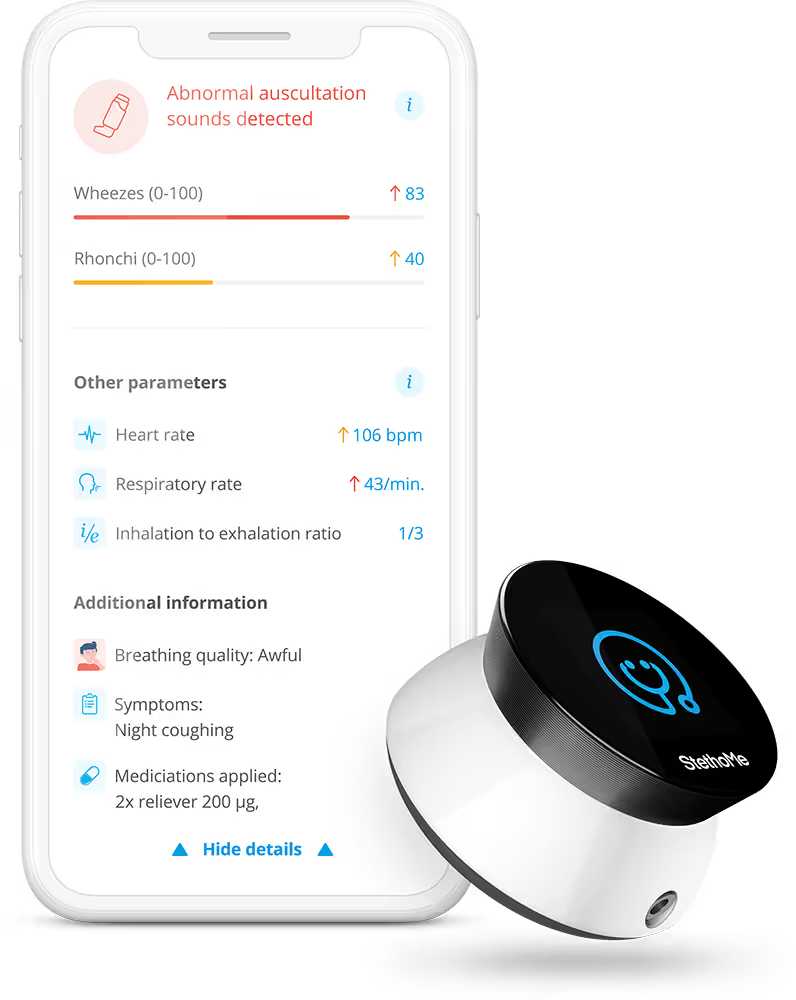



Wenn Sie Zweifel haben, überwachen Sie die Atmung aller Ihrer Familienmitglieder bequem zu Hause.
Sie werden die Ergebnisse sofort erfahren.
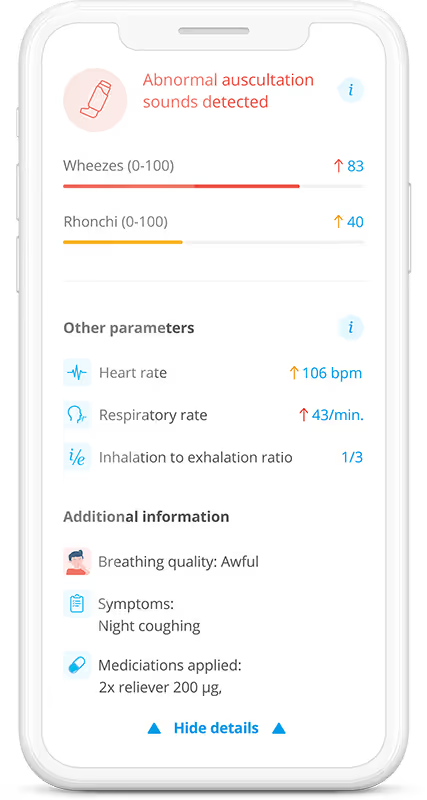
StethoMe® hat abnorme Geräusche entdeckt? Suchen Sie dringend Ihren Arzt auf. Sie können die Untersuchungsaufzeichnung und die Ergebnisse online teilen.
Handeln Sie schneller.
.svg)

.svg)
.svg)
.svg)
Ein Gerät für alle Familienmitglieder
Mit einem StethoMe Gerät überwachen Sie die Lungengesundheit der ganzen Familie , ohne dass Sie separate Geräte kaufen müssen.
Mobilität
Das Gerät ist überall auf der Welt und zu jeder Zeit einsatzbereit, was es perfekt für lange und kurze Reisen macht.
Machen Sie sich keine Sorgen, sondern handeln Sie.
Wenn StethoMe abnormale Geräusche feststellt, können Sie einfach Ihre Untersuchungsergebnisse mitteilen und Ihren Arzt aus der Ferne konsultieren. Auf diese Weise gewinnt die ganze Familie mehr Zeit, um die Reise gemeinsam zu genießen.
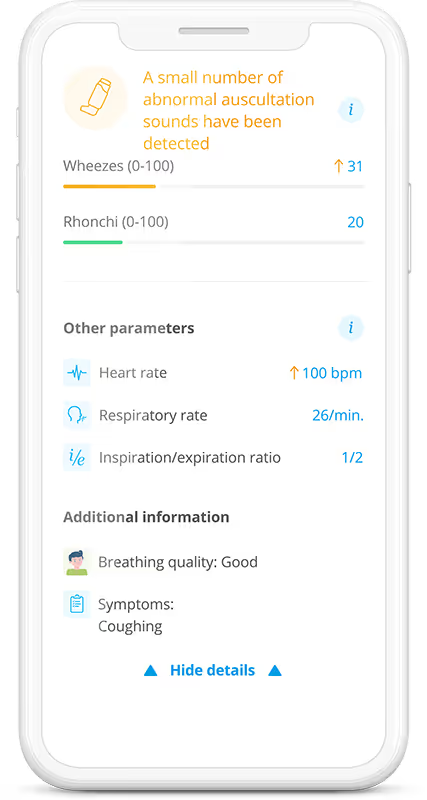
StethoMe® ist unglaublich empfindlich und erkennt Keuchen, das bisher nur von einem Arzt mit einem Stethoskop wahrgenommen werden konnte.
Keuchen, das trotz einer entzündungshemmenden Behandlung auftritt, kann ein Hinweis darauf sein, dass die Dosierung der Medikamente geändert werden muss.
Hören Sie Ihre Lunge alle paar Tage für 30 Sekunden ab. Wenn Sie ein leises Keuchen feststellen, wenden Sie sich an Ihren Arzt, um angemessen zu reagieren.
Wenn Sie Asthmatiker sind, warten Sie nicht, bis Husten, Kurzatmigkeit oder Keuchen auftreten. Sobald sich die Symptome deutlich verschlimmern, ist es schwieriger, den akuten Zustand zu kontrollieren, und Sie benötigen möglicherweise bronchienerweiternde Medikamente.
Handeln Sie vorausschauend.
StethoMe wird von der Pädiatrischen Sektion der Polnischen Gesellschaft für Allergologie und der Polnischen Gesellschaft für Pädiatrische Pneumologie zur Anwendung bei Asthma bei Kindern und zur Unterstützung bei telemedizinischen Besuchen empfohlen.


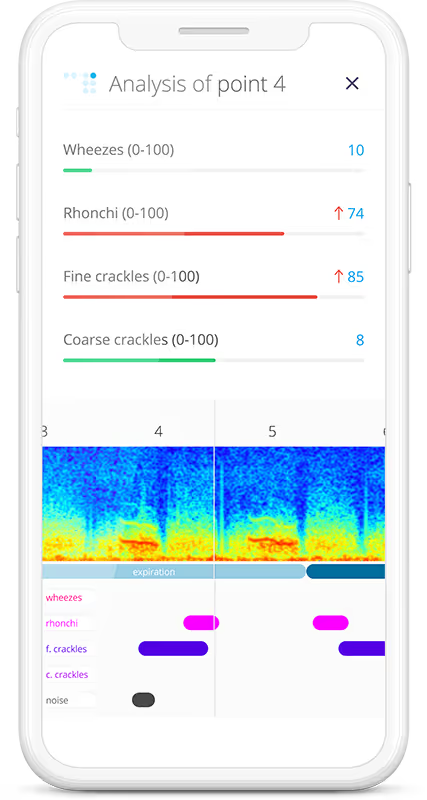
Das System erkennt abnormale Atemgeräusche und misst andere Parameter, die bei Atemwegsinfektionen und chronischen Erkrankungen wie Asthma von entscheidender Bedeutung sind.
Giemen und Brummen:
Diese Geräusche treten häufig bei Exazerbationen von Asthma bronchiale, Bronchiolitis und Bronchitis sowie bei Verstopfung der oberen Atemwege auf.
Feinblasigen Rasselgeräuschen und Grobblasige Rasselgeräusche:
Diese Geräusche treten häufig bei Lungenentzündung, Bronchitis, Bronchiolitis und bronchialer Stauung auf.
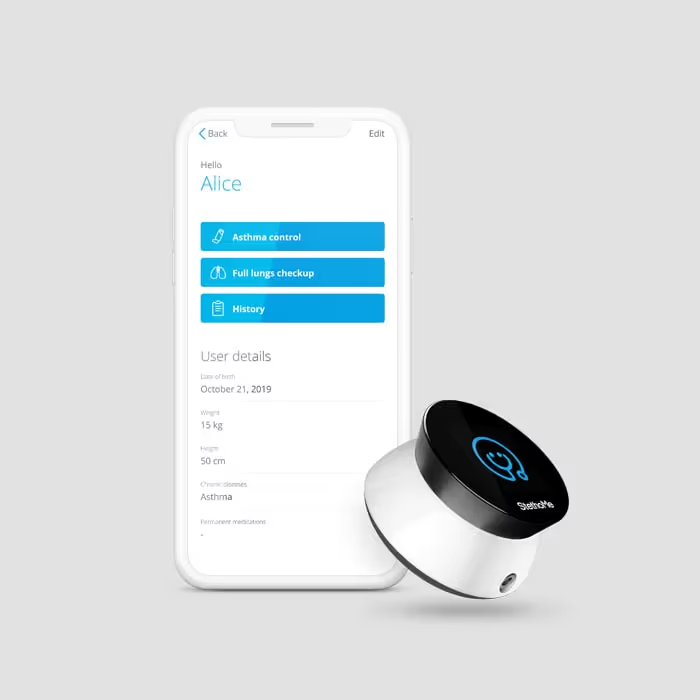

Laden Sie die StethoMe®-App herunter, die Sie durch den Check-up führt.
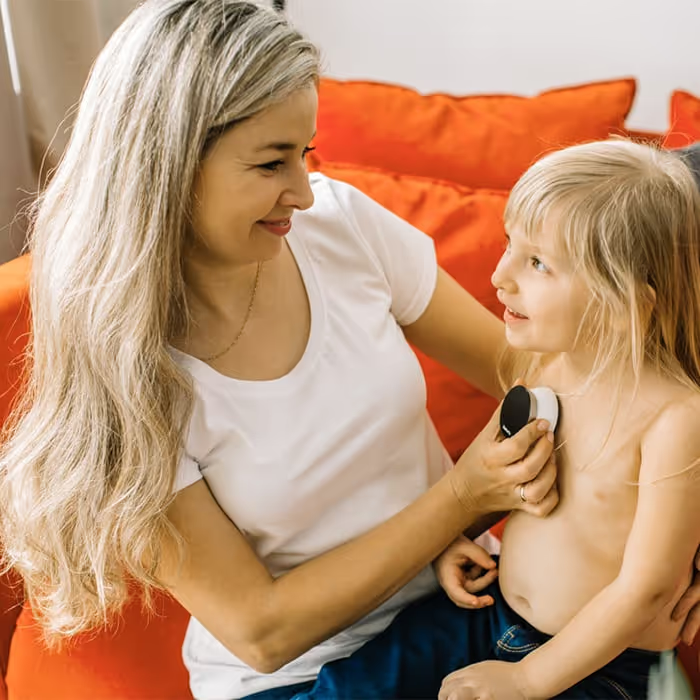

Legen Sie das Gerät einfach wie in der App angegeben auf die Brust.
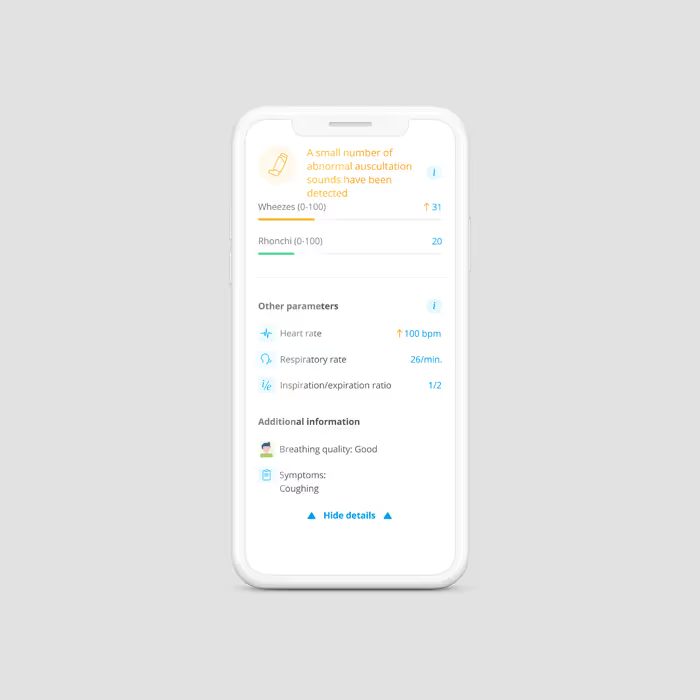
Erhalten Sie sofort Ihre Ergebnisse und teilen Sie sie mit Ihrem Arzt.
StethoMe informiert Sie sofort, wenn einer der analysierten Parameter abnormal ist.
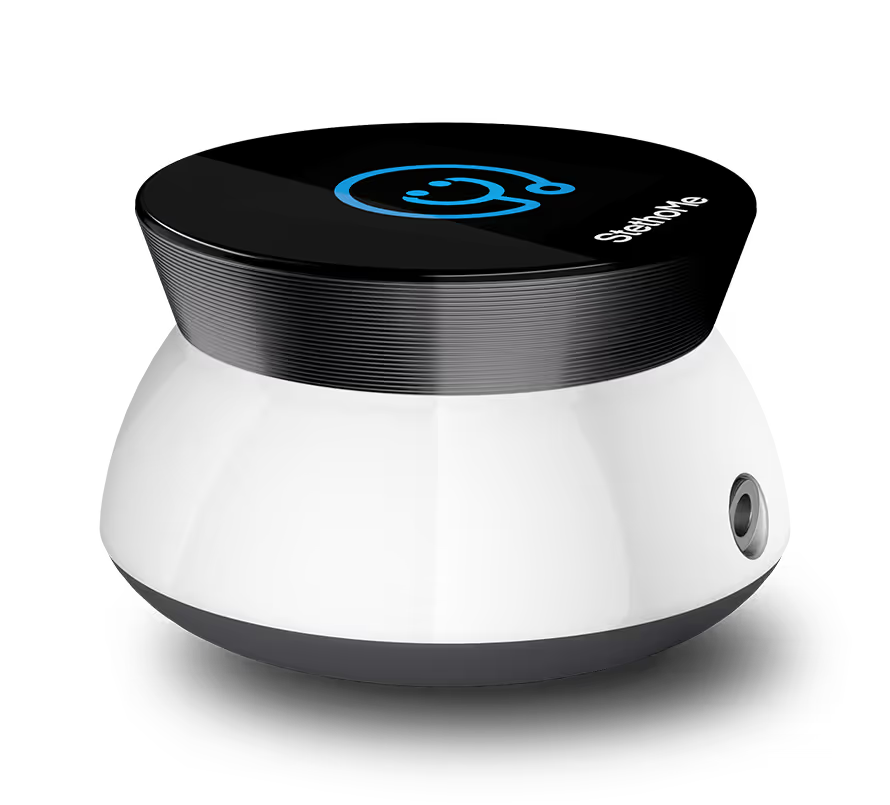
Stellen Sie sich einen Arzt vor, der die Erfahrung von mehr als 42 000 Atemwegsauskultationen bei Kindern gesammelt hat und diese interpretiert. Jemand, der nie müde ist, immer zur Verfügung steht, nie schlecht gelaunt ist und ein ausgezeichnetes Gehör hat.
Wir stellen StethoMe® vor. Ein medizinisches Stethoskop für zu Hause, das das Ergebnis von über 8 Jahren Arbeit von 60 Experten und Wissenschaftlern ist.
StethoMe wurde von der Pädiatrischen Sektion der Polnischen Gesellschaft für Allergologie und der Polnischen Gesellschaft für Pädiatrische Pulmonologie für den Einsatz bei pädiatrischem Asthma und als Erweiterung der telemedizinischen Beratung empfohlen.





Effective and reliable monitoring of asthma at home is a relevant factor that may reduce the need to consult a doctor in person.
We analyzed the possibility to determine intensities of pathological breath phenomena based on artificial intelligence (AI) analysis of sounds recorded during standard stethoscope auscultation.
The evaluation set comprising 1,043 auscultation examinations (9,319 recordings) was collected from 899 patients. Examinations were assigned to one of four groups: asthma with and without abnormal sounds (AA and AN, respectively), no-asthma with and without abnormal sounds (NA and NN, respectively). Presence of abnormal sounds was evaluated by a panel of 3 physicians that were blinded to the AI predictions. AI was trained on an independent set of 9,847 recordings to determine intensity scores (indexes) of wheezes, rhonchi, fine and coarse crackles and their combinations: continuous phenomena (wheezes + rhonchi) and all phenomena. The pair-comparison of groups of examinations based on Area Under ROC-Curve (AUC) was used to evaluate the performance of each index in discrimination between groups.
Best performance in separation between AA and AN was observed with Continuous Phenomena Index (AUC 0.94) while for NN and NA. All Phenomena Index (AUC 0.91) showed the best performance. AA showed slightly higher prevalence of wheezes compared to NA.
The results showed a high efficiency of the AI to discriminate between the asthma patients with normal and abnormal sounds, thus this approach has a great potential and can be used to monitor asthma symptoms at home.
Hafke-Dys H, Kuźnar-Kamińska B, Grzywalski T, Maciaszek A, Szarzyński K, Kociński J.
Auscultation is one of the first examinations that a patient is subjected to in a GP’s office, especially in relation to diseases of the respiratory system. However it is a highly subjective process and depends on the physician’s ability to interpret the sounds as determined by his/ her psychoacoustical characteristics.
Here, we present a cross-sectional assessment of the skills of physicians of different specializations and medical students in the classification of respiratory sounds in children.
185 participants representing different medical specializations took part in the experiment. The experiment comprised 24 respiratory system auscultation sounds. The participants were tasked with listening to, and matching the sounds with provided descriptions of specific sound classes. The results revealed difficulties in both the recognition and description of respiratory sounds. The pulmonologist group was found to perform significantly better than other groups in terms of number of correct answers. We also found that performance significantly improved when similar sound classes were grouped together into wider, more general classes.
These results confirm that ambiguous identification and interpretation of sounds in auscultation is a generic issue which should not be neglected as it can potentially lead to inaccurate diagnosis and mistreatment. Our results lend further support to the already widespread acknowledgment of the need to standardize the nomenclature of auscultation sounds (according to European Respiratory Society, International Lung Sounds Association and American Thoracic Society). In particular, our findings point towards important educational challenges in both theory (nomenclature) and practice (training).
Honorata Hafke-Dys, Anna Bręborowicz, Paweł Kleka, Jędrzej Kociński, Adam Biniakowski
Lung auscultation is an important part of a physical examination. However, its biggest drawback is its subjectivity. The results depend on the experience and ability of the doctor to perceive and distinguish pathologies in sounds heard via a stethoscope. This paper investigates a new method of automatic sound analysis based on neural networks (NNs), which has been implemented in a system that uses an electronic stethoscope for capturing respiratory sounds. It allows the detection of auscultatory sounds in four classes: wheezes, rhonchi, and fine and coarse crackles. In the blind test, a group of 522 auscultatory sounds from 50 pediatric patients were presented, and the results provided by a group of doctors and an artificial intelligence (AI) algorithm developed by the authors were compared. The gathered data show that machine learning (ML)–based analysis is more efficient in detecting all four types of phenomena, which is reflected in high values of recall (also called as sensitivity) and F1-score.
Conclusions: The obtained results suggest that the implementation of automatic sound analysis based on NNs can significantly improve the efficiency of this form of examination, leading to a minimization of the number of errors made in the interpretation of auscultation sounds.
Tomasz Grzywalski, Mateusz Piecuch, Marcin Szajek, Anna Bręborowicz, Honorata Hafke-Dys, Jędrzej Kociński, Anna Pastusiak, Riccardo Belluzzo
A stethoscope, introduced more than two centuries ago, is still a tool providing potentially valuable information gained during one of the most common examinations. However, the biggest drawback of auscultation is its subjectivity. It depends mainly on the experience and ability of the doctor to perceive and distinguish pathological signals. Many research has shown very low efficiency of doctors in this area.
Moreover, most physicians are aware of this problem and need supporting devices. Therefore we have developed the Artificial Intelligence (AI) algorithms which recognise pathological sounds (wheezes, rhonchi, fine and coarse crackles). Here we present the comparison of the performance of physicians and AI in detection of those sounds.
A database of more than 10 000 recordings described by a consilium of specialists (pulmonologists and acousticians) was used for AI learning. Then another set of more than 500 real auscultatory sounds were used to investigate the efficiency of AI in comparison to a group of doctors. The standard F1-score was used for evaluation, because it considers both the precision and the recall. For each phenomena, the results for the AI is higher than for doctors with an average advantage of 8.4 percentage points, reaching even 13,5 p.p. for fine crackles.
The results suggest that the implementation of AI can significantly improve the efficiency of auscultation in everyday practice making it more objective, leading to a minimization of errors. The solution is now being tested with a group of hospitals and medical providers and proves its efficiency and usability in everyday practice making this examination faster and more reliable.
Tomasz Grzywalski, Marcin Szajek, Honorata Hafke-Dys, Anna Bręborowicz, Jędrzej Kociński, Anna Pastusiak, Riccardo Belluzzo
Performing an auscultation of the respiratory system normally requires the presence of an experienced doctor, but the most recent advances in artificial intelligence (AI) open up a possibility for the laymen to perform this procedure by himself in home environment. However, to make it feasible, the system needs to include two main components: an algorithm for fast and accurate detection of breath phenomena in stethoscope recordings and an AI agent that interactively guides the end user through the auscultation process. In this work we present a system that solves both of these problems using state-of-the-art machine learning algorithms. Our breath phenomena detection model was trained on 5000 stethoscope recordings of both sick (hospitalized) and healthy children. All recordings were labeled by a pulmonologist and acousticians. Trained model shows nearly optimal performance in terms of both sensitivity and specificity when tested on unseen recordings. The agent is able to accurately assess a patient's lung health status by auscultating only 3 out of 12 locations on average. The decision about each next auscultation location or end of examination is made dynamically, after each recording, based on breath phenomena detected so far. This allows the agent to make the best prediction even if the auscultation is time-constrained.
Tomasz Grzywalski, Riccardo Belluzzo, Mateusz Piecuch, Marcin Szajek, Anna Bręborowicz, Anna Pastusiak, Honorata Hafke-Dys, Jędrzej Kociński
To perform a precise auscultation for the purposes of examination of the respiratory system normally requires the presence of an experienced doctor. With most recent advances in machine learning and artificial intelligence, automatic detection of pathological breath phenomena in sounds recorded with a stethoscope becomes a reality. But to perform a full auscultation in a home environment by a layman is another matter, especially if the patient is a child. In this paper we propose a unique application of Reinforcement Learning for training an agent that interactively guides the end user throughout the auscultation procedure. We show that intelligent selection of auscultation points by the agent reduces time of the examination fourfold without significant decrease in diagnosis accuracy compared to exhaustive auscultation.
Tomasz Grzywalski, Riccardo Belluzzo, Szymon Drgas, Agnieszka Cwalińska, Honorata Hafke-Dys
In this article a DNN-based system for detection of three common voice disorders (vocal nodules, polyps and cysts; laryngeal neoplasm; unilateral vocal paralysis) is presented. The input to the algorithm is (at least 3-second long) audio recording of sustained vowel sound /a:/. The algorithm was developed as part of the ”2018 FEMH Voice Data Challenge” organized by Far Eastern Memorial Hospital and obtained a score value (defined in the challenge specification) of 77.44. This was the second best result before final submission. Final challenge results are not yet known during writing of this document. The document also reports changes that were made for the final submission which improved the score value in cross-validation by 0.6% points.
Tomasz Grzywalski., Adam Maciaszek, Adam Biniakowski, JanOrwat, Szymon Drgas, Mateusz Piecuch, Riccardo Belluzzo, Krzysztof Joachimiak, Dawid Niemiec, Jakub Ptaszyński, Krzysztof Szarzyński
In the case of children suffering from chronic diseases of the respiratory system, including asthma, it is very important to track any changes in the respiratory system condition. Domestic patient monitoring is becoming more and more popular. It is much more comfortable for patients who are less stressed, being relieved from any necessity to attend doctor’s offices, and are not exposed to pathogens present in medical facilities. Furthermore, it is also important for the attending physician who is provided with documented data. Until now, any aggravation of a past disease has been reported by children’s parents during medical appointments. Such a method for providing information entails potential miscommunication, misjudgement and highly biased evaluation. A solution might be an electronic stethoscope, providing an easy way to examine children in domestic conditions and to record auscultation results. Currently, it is possible to record auscultation sounds, provide a doctor with remote access to such records, and also to report any appearance of specific sounds and their intensity. Based on collaboration with scientific centres, there is a solution being developed: StethoMe®, a smart stethoscope, designed to provide a patient with a method for domestic auscultation. This system enables recording of auscultation sounds, submitting them to a physician and automatic classification of recorded sounds in four classes: wheezes, fine crackles, coarse crackles and rhonchi, according to [1]. a physician may see a panel with provided access to sounds, their spectrograms, being visualisations of sounds facilitating their interpretation, and also an algorithm report, related to potential appearance of specific pathologies. This solution is currently under development and in a testing phase in Europe.
Honorata Hafke-Dys, Anna Zelent