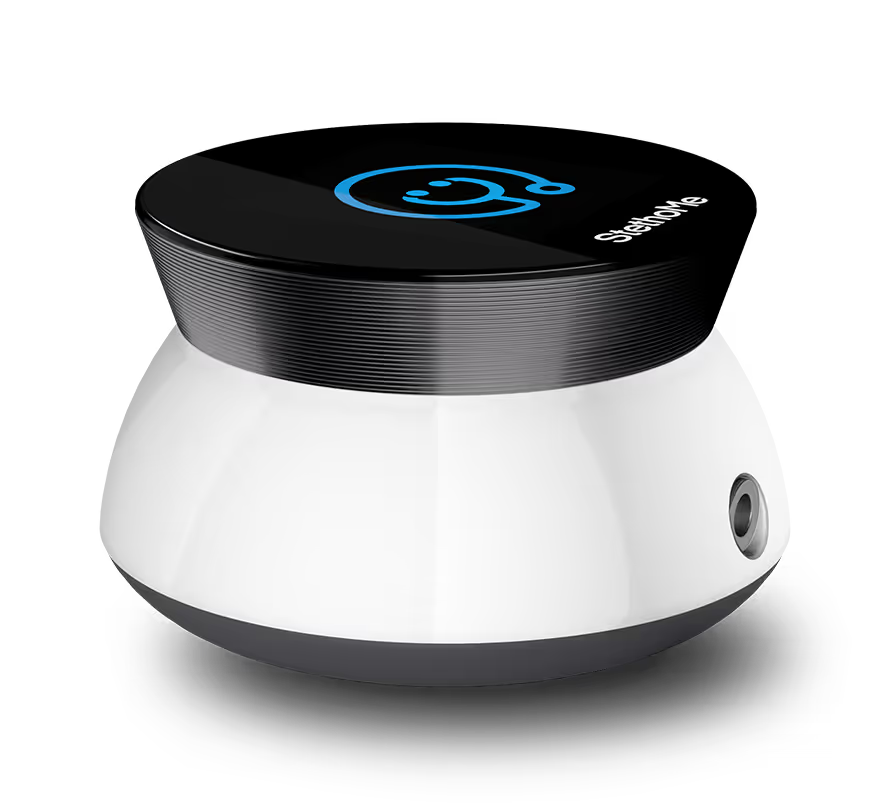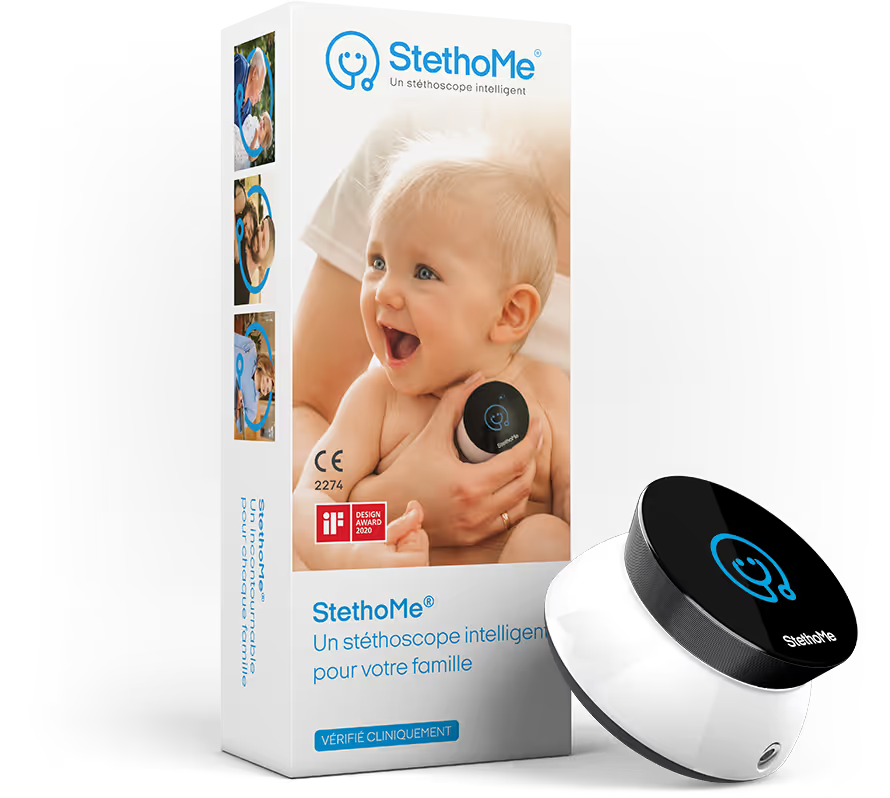
StethoMe® im Familienplan kaufen.

Überwachen Sie die Gesundheit Ihrer Familie mit einem intelligenten Stethoskop.

StethoMe® AI erkennt abnormale Geräusche im Atmungssystem. Damit können Sie Ihre Lungen zu Hause auskultieren und erhalten ein sofortiges und zuverlässiges Untersuchungsergebnis. Außerdem können Sie, um eine schnelle und sichere Diagnose zu bekommen, senden Sie alle Ergebnisse der durchgeführten Untersuchung an Ihren zuständigen Arzt.

Haben Sie bereits StethoMe®? Kaufen Sie eine Lizenz

Mit Hilfe des intelligenten StethoMe-Stethoskops werden Sie:

Sich selbst, Ihr Kind und alle Familienmitglieder schnell, professionell, überall und jederzeit auskultieren.
Erkennen Sie Geräusche, die im Verlauf einer Lungenentzündung und Bronchitis auftreten, oder Geräusche, die für eine Asthmaexazerbation charakteristisch sind.
Bestimmen Sie wichtige physiologische Parameter: Herzfrequenz (BPM), Atemfrequenz (RR) und Inspirations-Exspirations-Verhältnis (I/E).
Teilen Sie Ihrem Arzt die Ergebnisse des Tests schnell mit.
Erhalten Sie über die App Zugriff auf Ihre Krankengeschichte.

Sie erhalten eine 24-monatige Garantie

Im StethoMe Family-Tarif können Sie bis zu 4 Patienten hinzufügen und haben Zugriff auf die Verlaufsdaten über einen Zeitraum von 3 Monaten. Im StethoMe Plus-Tarif (ehemals StethoMe Asthma) haben Sie zusätzlich Zugang zu einem Keuchhusten-Kontrollmodus für chronische Krankheiten, können bis zu 6 Patienten hinzufügen und haben über einen Zeitraum von 24 Monaten Zugang zu den Verlaufsdaten.

Die StethoMe-App ist sowohl auf Android- als auch auf iOS-Plattformen verfügbar. Unterstützte Software-Versionen: Android 9 (und höher) und iOS 15 (und höher).

Häufig gestellte Fragen (FAQ)

Was ist StethoMe®?
Close icon

tethoMe ist eine innovative Lösung. Sie ermöglicht es Ihnen, die Atmung zu überwachen und abnorme Atemgeräusche effektiv zu erkennen. Die Kombination des StethoMe-Stethoskops mit den StethoMe-KI-Algorithmen ermöglicht die Identifizierung und Messung der Intensität von:

  • Giemen und Brummen. Diese Geräusche treten häufig bei Exazerbationen von Asthma bronchiale, Bronchiolitis und Bronchitis sowie bei Verstopfung der oberen Atemwege auf.
  • Feinblasigen Rasselgeräuschen und Grobblasige Rasselgeräusche. Diese Geräusche treten häufig bei Lungenentzündung, Bronchitis, Bronchiolitis und bronchialer Stauung auf.

Mit StethoMe können Sie die ersten Symptome zu Hause überwachen, den Bedarf an persönlichen Besuchen reduzieren und Ihrem Arzt wichtige Daten für eine effektive Behandlung liefern.

Die App unterstützt Sie während der gesamten Untersuchung und analysiert Ihre Aufzeichnungen mit Hilfe unserer Algorithmen (StethoMe AI). Das Ergebnis erhalten Sie innerhalb weniger Augenblicke auf dem Bildschirm. Sie brauchen nichts weiter zu tun, da der gesamte Prozess automatisch abläuft. Außerdem können Sie die Aufnahmen und Untersuchungsergebnisse ganz einfach mit Ihrem Arzt teilen

Sowohl das StethoMe Stethoskop als auch die StethoMe AI Algorithmen sind Medizinprodukte (CE 2274).

Dies ist ein medizinisches Gerät. Verwenden Sie es gemäß der Gebrauchsanweisung oder dem Etikett. Der Hersteller und Anbieter ist StethoMe Sp. z. o.o.

Wer kann StethoMe® benutzen?
Close icon

Mit dem StethoMe-Stethoskop können Sie die Auskultation von Kindern und Erwachsenen zu Hause durchführen, auch wenn Sie keine medizinische Ausbildung haben. StethoMe kann in allen Altersgruppen verwendet werden. Bitte beachten Sie, dass aufgrund der hohen physiologischen Variabilität der ermittelten Parameter die Ergebnisse für Kinder unter 1 Jahr immer mit einem Arzt abgesprochen werden sollten. Für diese Altersgruppe ist besondere Vorsicht geboten.

Eine Auskultationsuntersuchung mit dem StethoMe kann auch von einem Arzt und medizinischem Personal durchgeführt werden. Sowohl das StethoMe-Stethoskop als auch der StethoMe AI-Algorithmus sind Medizinprodukte (CE 2274).

Wird die StethoMe®-App von allen Smartphones unterstützt?
Close icon

Die StethoMe-App ist sowohl auf Android- als auch auf iOS-Plattformen verfügbar. Unterstützte Software-Versionen: Android 9 (und höher) und iOS 15 (und höher).

Ist StethoMe® nur für Menschen mit Infektionen geeignet? Was ist, wenn ich oder mein Kind Asthma oder Mukoviszidose hat?
Close icon

StethoMe wird von der Pädiatrischen Sektion der Polnischen Gesellschaft für Allergologie und der Polnischen Gesellschaft für Pädiatrische Pneumonologie zur Anwendung bei Asthma bei Kindern und zur Unterstützung bei telemedizinischen Besuchen empfohlen

Es kann zur Auskultation bei Patienten mit Asthma, chronisch obstruktiver Lungenerkrankung (COPD), zystischer Fibrose, Kruppsyndrom, Bronchitis, Lungenentzündung oder anderen akuten und chronischen Atemwegserkrankungen eingesetzt werden.

Es ist jedoch zu beachten, dass bei einigen Atemwegserkrankungen (z. B. bei einer asymptomatischen Lungenentzündung) keine auskultatorischen Veränderungen auftreten, so dass die Ergebnisse der Tests nicht eindeutig sein können. Wenn sich Ihre Symptome verschlimmern oder länger andauern, sollten Sie auf jeden Fall Ihren Arzt aufsuchen.

Die medizinischen Algorithmen von StethoMe AI erkennen und bestimmen die Intensität abnormaler Auskultationsgeräusche wie Keuchen, Rhonchi, feines und grobes Knistern. Sie messen auch die Atemfrequenz, das Verhältnis von Inspiration und Exspiration sowie die Herzfrequenz. Sie können Ihre Testergebnisse aus der StethoMe-App direkt an Ihren Arzt senden.

Wie funktioniert StethoMe®
Close icon

StethoMe ist ein drahtloses elektronisches Stethoskop, das mit einer speziellen Telefon-App funktioniert. Das Stethoskop wird über Bluetooth (Low Energy)-Technologie mit Ihrem Telefon verbunden.

Damit StethoMe® funktioniert, benötigen Sie:

  • StethoMe® -Stethoskop (erhältlich mit einem Abonnement auf unserer Website),
  • Internetzugang (auf Ihrem Telefon aktiviert),
  • die neueste Version der StethoMe®-App (zum Herunterladen im Google Play Store oder App Store).

Die App unterstützt Sie während der gesamten Untersuchung und analysiert Ihre Aufnahmen mit Hilfe unserer Algorithmen (StethoMe® AI). Innerhalb weniger Augenblicke erhalten Sie das Ergebnis auf dem Bildschirm. Sie brauchen nichts weiter zu tun, da der gesamte Prozess automatisch abläuft. Außerdem können Sie die Aufnahmen und Testergebnisse ganz einfach mit Ihrem Arzt teilen.

Sehen Sie nach, wie StethoMe funktioniert.

Ich bin ein Arzt. Kann ich StethoMe® verwenden?
Close icon

Sowohl das StethoMe-Stethoskop als auch die StethoMe AI-Algorithmen, die die Geräusche des Stethoskops analysieren, sind Medizinprodukte der Klasse IIa (CE 2274) und erfüllen die Anforderungen der MDD-Richtlinie 93/42/EWG. Sie können StethoMe in Ihrer täglichen Praxis verwenden.

Was erkennt StethoMe® ?
Close icon

Je nach Untersuchungsmodus kann StethoMe AI:

  • erkennt und bestimmt die Intensität abnormaler Atemgeräusche wie z. B.:
    • Giemen,
    • Brummen,
    • Feinblasig Rasselgeräusch,
    • Grobblasig Rasselgeräusch,
  • messung:
    • Atmungsrate (RR),
    • Inspirations-Exspirations-Verhältnis (I/E),
    • Herzfrequenz (BPM).

Denken Sie daran, dass nur Ihr Arzt Entscheidungen über Ihre Behandlung treffen kann. Schicken Sie Ihre Ergebnisse zur Beratung und Diagnose an Ihren Arzt.

Was ist im Preis von StethoMe® enthalten?
Close icon

Als Teil Ihres Kaufs erhalten Sie:

  • ein elektronisches Stethoskop,
  • sofortigen Zugang zu den Ergebnissen der von den medizinischen KI-Algorithmen von StethoMe durchgeführten Analyse der Aufnahmen,
  • Möglichkeit, dem Konto mehrere Patienten hinzuzufügen (Anzahl hängt vom gewählten Tarif ab),
  • die Möglichkeit, Links oder Dateien mit Ergebnissen zu erstellen und zu versenden, um einen Arzt zu konsultieren.

Wenn Sie Fragen oder Bedenken haben, kontaktieren Sie uns bitte unter: support@StethoMe.com.

Überwachen Sie den Gesundheitszustand Ihrer Familie zu Hause und informieren Sie sich unterwegs über die Untersuchungsergebnisse

Das System erkennt abnormale Atemgeräusche und misst die Atmungsparameter, die für die Erkennung erster Anzeichen einer Infektion oder die Steuerung der Behandlung von Lungenentzündung, Bronchitis, Asthma usw. entscheidend sind.
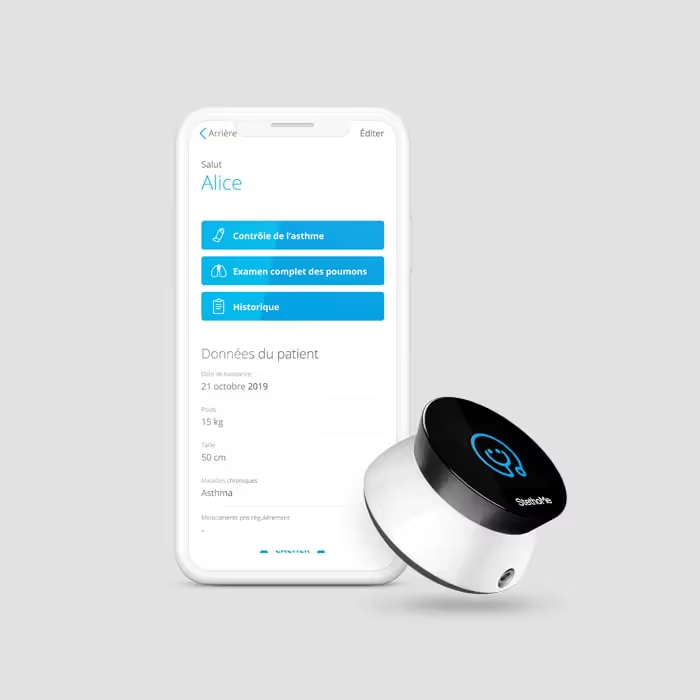
1

Schalten Sie das Stethoskop und die Anwendung StethoMe auf Ihrem Telefon ein. Die Geräte verbinden sich automatisch.

2

Setzen Sie das Stethoskop auf die Brust Ihres Kindes. Das System führt Sie durch den gesamten Vorgang und informiert Sie, wenn die Messung falsch ist oder die Umgebung zu laut ist. Lesen Sie die Anweisungen.
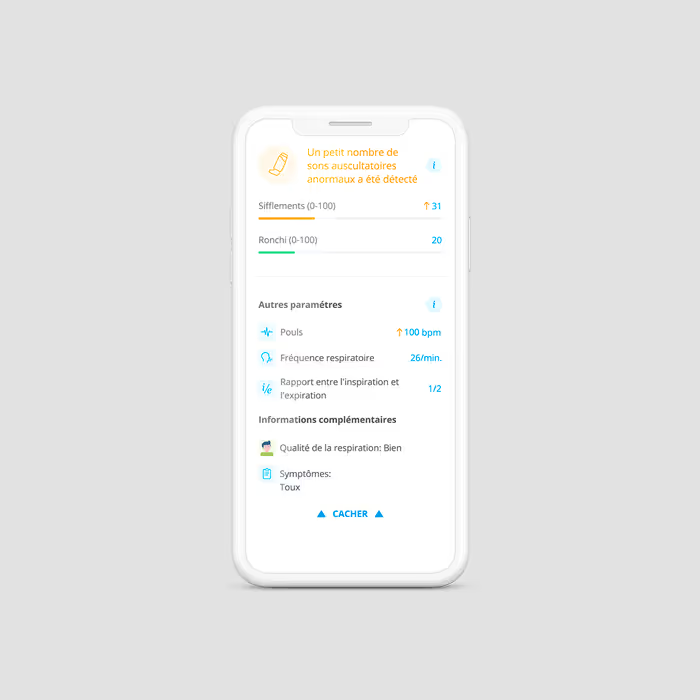
3

Sie können sehen, ob die Untersuchung die für Lungenentzündung und Bronchitis oder Asthmaexazerbationen charakteristischen Geräusche zeigt.

StethoMe® wird Sie sofort informieren, wenn einer der analysierten Parameter abnormal ist.

Partners

Wissenschaftliche Veröffentlichungen / Klinische Forschung

Bei StethoMe® legen wir großen Wert auf die Wissenschaft hinter unseren Lösungen. Wir teilen unser Wissen, indem wir die Ergebnisse unserer Forschung in führenden wissenschaftlichen Zeitschriften veröffentlichen und aktiv mit der akademischen Gemeinschaft zusammenarbeiten.
Frontiers in Physiology
Artificial Intelligence Approach to the Monitoring of Respiratory Sounds in Asthmatic Patients
Close icon
Background

Effective and reliable monitoring of asthma at home is a relevant factor that may reduce the need to consult a doctor in person.

Aim

We analyzed the possibility to determine intensities of pathological breath phenomena based on artificial intelligence (AI) analysis of sounds recorded during standard stethoscope auscultation.

Methods

The evaluation set comprising 1,043 auscultation examinations (9,319 recordings) was collected from 899 patients. Examinations were assigned to one of four groups: asthma with and without abnormal sounds (AA and AN, respectively), no-asthma with and without abnormal sounds (NA and NN, respectively). Presence of abnormal sounds was evaluated by a panel of 3 physicians that were blinded to the AI predictions. AI was trained on an independent set of 9,847 recordings to determine intensity scores (indexes) of wheezes, rhonchi, fine and coarse crackles and their combinations: continuous phenomena (wheezes + rhonchi) and all phenomena. The pair-comparison of groups of examinations based on Area Under ROC-Curve (AUC) was used to evaluate the performance of each index in discrimination between groups.

Results

Best performance in separation between AA and AN was observed with Continuous Phenomena Index (AUC 0.94) while for NN and NA. All Phenomena Index (AUC 0.91) showed the best performance. AA showed slightly higher prevalence of wheezes compared to NA.

Conclusions

The results showed a high efficiency of the AI to discriminate between the asthma patients with normal and abnormal sounds, thus this approach has a great potential and can be used to monitor asthma symptoms at home.

Hafke-Dys H, Kuźnar-Kamińska B, Grzywalski T, Maciaszek A, Szarzyński K, Kociński J.

PLoS ONE
The accuracy of lung auscultation in the practice of physicians and medical students
Close icon
Background

Auscultation is one of the first examinations that a patient is subjected to in a GP’s office, especially in relation to diseases of the respiratory system. However it is a highly subjective process and depends on the physician’s ability to interpret the sounds as determined by his/ her psychoacoustical characteristics.
Here, we present a cross-sectional assessment of the skills of physicians of different specializations and medical students in the classification of respiratory sounds in children.

Methods and findings

185 participants representing different medical specializations took part in the experiment. The experiment comprised 24 respiratory system auscultation sounds. The participants were tasked with listening to, and matching the sounds with provided descriptions of specific sound classes. The results revealed difficulties in both the recognition and description of respiratory sounds. The pulmonologist group was found to perform significantly better than other groups in terms of number of correct answers. We also found that performance significantly improved when similar sound classes were grouped together into wider, more general classes.

Conclusions

These results confirm that ambiguous identification and interpretation of sounds in auscultation is a generic issue which should not be neglected as it can potentially lead to inaccurate diagnosis and mistreatment. Our results lend further support to the already widespread acknowledgment of the need to standardize the nomenclature of auscultation sounds (according to European Respiratory Society, International Lung Sounds Association and American Thoracic Society). In particular, our findings point towards important educational challenges in both theory (nomenclature) and practice (training).

Honorata Hafke-Dys, Anna Bręborowicz, Paweł Kleka, Jędrzej Kociński, Adam Biniakowski

European Journal of Pediatrics
Practical implementation of artificial intelligence algorithms in pulmonary auscultation examination
Close icon

Lung auscultation is an important part of a physical examination. However, its biggest drawback is its subjectivity. The results depend on the experience and ability of the doctor to perceive and distinguish pathologies in sounds heard via a stethoscope. This paper investigates a new method of automatic sound analysis based on neural networks (NNs), which has been implemented in a system that uses an electronic stethoscope for capturing respiratory sounds. It allows the detection of auscultatory sounds in four classes: wheezes, rhonchi, and fine and coarse crackles. In the blind test, a group of 522 auscultatory sounds from 50 pediatric patients were presented, and the results provided by a group of doctors and an artificial intelligence (AI) algorithm developed by the authors were compared. The gathered data show that machine learning (ML)–based analysis is more efficient in detecting all four types of phenomena, which is reflected in high values of recall (also called as sensitivity) and F1-score.

Conclusions: The obtained results suggest that the implementation of automatic sound analysis based on NNs can significantly improve the efficiency of this form of examination, leading to a minimization of the number of errors made in the interpretation of auscultation sounds.

Tomasz Grzywalski, Mateusz Piecuch, Marcin Szajek, Anna Bręborowicz, Honorata Hafke-Dys, Jędrzej Kociński, Anna Pastusiak, Riccardo Belluzzo

ERS International Congress
Respiratory system auscultation using machine learning - a big step towards objectivisation?
Close icon

A stethoscope, introduced more than two centuries ago, is still a tool providing potentially valuable information gained during one of the most common examinations. However, the biggest drawback of auscultation is its subjectivity. It depends mainly on the experience and ability of the doctor to perceive and distinguish pathological signals. Many research has shown very low efficiency of doctors in this area.

Moreover, most physicians are aware of this problem and need supporting devices. Therefore we have developed the Artificial Intelligence (AI) algorithms which recognise pathological sounds (wheezes, rhonchi, fine and coarse crackles). Here we present the comparison of the performance of physicians and AI in detection of those sounds.

A database of more than 10 000 recordings described by a consilium of specialists (pulmonologists and acousticians) was used for AI learning. Then another set of more than 500 real auscultatory sounds were used to investigate the efficiency of AI in comparison to a group of doctors. The standard F1-score was used for evaluation, because it considers both the precision and the recall. For each phenomena, the results for the AI is higher than for doctors with an average advantage of 8.4 percentage points, reaching even 13,5 p.p. for fine crackles.

The results suggest that the implementation of AI can significantly improve the efficiency of auscultation in everyday practice making it more objective, leading to a minimization of errors. The solution is now being tested with a group of hospitals and medical providers and proves its efficiency and usability in everyday practice making this examination faster and more reliable.

Tomasz Grzywalski, Marcin Szajek, Honorata Hafke-Dys, Anna Bręborowicz, Jędrzej Kociński, Anna Pastusiak, Riccardo Belluzzo

Artificial Intelligence in Medicine
Fully Interactive Lungs Auscultation with AI Enabled Digital Stethoscope
Close icon

Performing an auscultation of the respiratory system normally requires the presence of an experienced doctor, but the most recent advances in artificial intelligence (AI) open up a possibility for the laymen to perform this procedure by himself in home environment. However, to make it feasible, the system needs to include two main components: an algorithm for fast and accurate detection of breath phenomena in stethoscope recordings and an AI agent that interactively guides the end user through the auscultation process. In this work we present a system that solves both of these problems using state-of-the-art machine learning algorithms. Our breath phenomena detection model was trained on 5000 stethoscope recordings of both sick (hospitalized) and healthy children. All recordings were labeled by a pulmonologist and acousticians. Trained model shows nearly optimal performance in terms of both sensitivity and specificity when tested on unseen recordings. The agent is able to accurately assess a patient's lung health status by auscultating only 3 out of 12 locations on average. The decision about each next auscultation location or end of examination is made dynamically, after each recording, based on breath phenomena detected so far. This allows the agent to make the best prediction even if the auscultation is time-constrained.

Tomasz Grzywalski, Riccardo Belluzzo, Mateusz Piecuch, Marcin Szajek, Anna Bręborowicz, Anna Pastusiak, Honorata Hafke-Dys, Jędrzej Kociński

Conference on Agents and Artificial Intelligence - ICAART
Interactive Lungs Auscultation with Reinforcement Learning Agent
Close icon

To perform a precise auscultation for the purposes of examination of the respiratory system normally requires the presence of an experienced doctor. With most recent advances in machine learning and artificial intelligence, automatic detection of pathological breath phenomena in sounds recorded with a stethoscope becomes a reality. But to perform a full auscultation in a home environment by a layman is another matter, especially if the patient is a child. In this paper we propose a unique application of Reinforcement Learning for training an agent that interactively guides the end user throughout the auscultation procedure. We show that intelligent selection of auscultation points by the agent reduces time of the examination fourfold without significant decrease in diagnosis accuracy compared to exhaustive auscultation.

Tomasz Grzywalski, Riccardo Belluzzo, Szymon Drgas, Agnieszka Cwalińska, Honorata Hafke-Dys

IEEE International Conference on Big Data
Parameterization of Sequence of MFCCs for DNN-based voice disorder detection
Close icon

In this article a DNN-based system for detection of three common voice disorders (vocal nodules, polyps and cysts; laryngeal neoplasm; unilateral vocal paralysis) is presented. The input to the algorithm is (at least 3-second long) audio recording of sustained vowel sound /a:/. The algorithm was developed as part of the ”2018 FEMH Voice Data Challenge” organized by Far Eastern Memorial Hospital and obtained a score value (defined in the challenge specification) of 77.44. This was the second best result before final submission. Final challenge results are not yet known during writing of this document. The document also reports changes that were made for the final submission which improved the score value in cross-validation by 0.6% points.

Tomasz Grzywalski., Adam Maciaszek, Adam Biniakowski, JanOrwat, Szymon Drgas, Mateusz Piecuch, Riccardo Belluzzo, Krzysztof Joachimiak, Dawid Niemiec, Jakub Ptaszyński, Krzysztof Szarzyński

Biochemistry, Molecular Biology & Allergy
Opportunities for domestic monitoring of children with an electronic stethoscope with automatic auscultation sound analysis system
Close icon

In the case of children suffering from chronic diseases of the respiratory system, including asthma, it is very important to track any changes in the respiratory system condition. Domestic patient monitoring is becoming more and more popular. It is much more comfortable for patients who are less stressed, being relieved from any necessity to attend doctor’s offices, and are not exposed to pathogens present in medical facilities. Furthermore, it is also important for the attending physician who is provided with documented data. Until now, any aggravation of a past disease has been reported by children’s parents during medical appointments. Such a method for providing information entails potential miscommunication, misjudgement and highly biased evaluation. A solution might be an electronic stethoscope, providing an easy way to examine children in domestic conditions and to record auscultation results. Currently, it is possible to record auscultation sounds, provide a doctor with remote access to such records, and also to report any appearance of specific sounds and their intensity. Based on collaboration with scientific centres, there is a solution being developed: StethoMe®, a smart stethoscope, designed to provide a patient with a method for domestic auscultation. This system enables recording of auscultation sounds, submitting them to a physician and automatic classification of recorded sounds in four classes: wheezes, fine crackles, coarse crackles and rhonchi, according to [1]. a physician may see a panel with provided access to sounds, their spectrograms, being visualisations of sounds facilitating their interpretation, and also an algorithm report, related to potential appearance of specific pathologies. This solution is currently under development and in a testing phase in Europe.

Honorata Hafke-Dys, Anna Zelent