This article is for informational purposes only.
For more than 200 years, physicians have relied on stethoscopes to assess respiratory health. Yet despite its importance, lung auscultation remains surprisingly subjective. Studies have shown that even experienced clinicians may interpret the same respiratory sounds differently, especially when those sounds are subtle.
This is one of the reasons why artificial intelligence has attracted growing interest in respiratory medicine.
Unlike X-rays or CT scans, auscultation is performed and interpreted in real time. Clinicians must identify brief and often subtle acoustic signals and distinguish them from normal breath sounds and background noise.
Two abnormal respiratory sounds are particularly important:
These sounds were the focus of an independent study conducted at Monash Children's Hospital in Melbourne, Australia, and published in Respiratory Research in 2020.*
Researchers from Monash University and Monash Children's Hospital wanted to answer an important question: can an AI algorithm accurately identify abnormal respiratory sounds even when recordings come from devices it was never trained on?
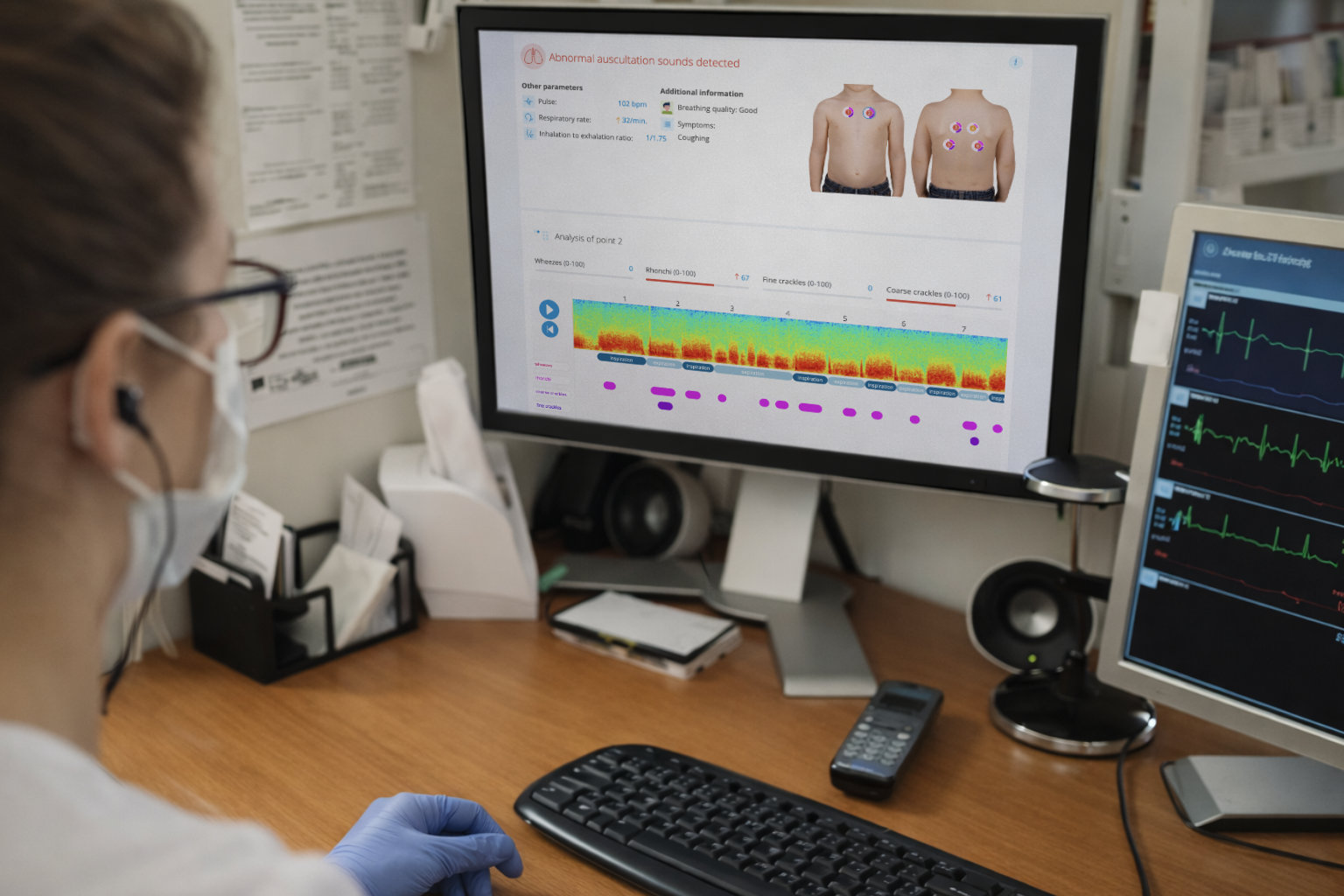
To answer this question, the researchers analyzed 192 lung sound recordings obtained from 25 children using two different digital stethoscopes. The recordings were independently evaluated by pediatric respiratory specialists and by the StethoMe AI algorithm.
Importantly, this was an independent study and was not conducted by the developers of the algorithm.
The results were striking. When analyzing recordings obtained with the Clinicloud digital stethoscope, StethoMe AI correctly identified crackles in approximately 95 out of 100 cases and wheezes in approximately 90 out of 100 cases. At the same time, it correctly identified when these abnormal sounds were not present in 99% and 97% of cases, respectively.
Performance was slightly lower when analyzing recordings from the Littmann electronic stethoscope, but remained high. The algorithm correctly identified approximately 80–82% of abnormal sounds and correctly excluded them in 95–96% of cases.
However, the most important finding was not the exact numbers.
The real challenge in this study was that the AI was tested using recordings from digital stethoscopes it had never encountered during training. Despite this, the algorithm maintained high performance across both devices.
In other words, StethoMe AI did not simply memorize sounds from a specific stethoscope. It learned to recognize the acoustic signatures of wheezes and crackles themselves - a critical requirement for any AI system intended for real-world clinical use.
Lung auscultation is an inherently complex clinical skill. Physicians never interpret respiratory sounds in isolation - they also consider symptoms, medical history, physical examination findings, and the patient's overall clinical condition.
This is precisely where artificial intelligence may provide additional value. AI does not replace physicians; instead, it offers an objective and repeatable way of analyzing respiratory sounds. Unlike human hearing, AI algorithms evaluate sounds according to the same criteria every time, unaffected by fatigue, experience level, or variations in examination conditions.
A few decades ago, measuring body temperature or blood pressure was largely limited to healthcare settings. Today, home thermometers, blood pressure monitors, and pulse oximeters are an integral part of everyday healthcare.
A similar transformation is now taking place in respiratory medicine. Certified medical devices using artificial intelligence, such as StethoMe, are already making respiratory sound analysis available beyond the doctor's office.
Just as thermometers did not replace physicians but transformed fever monitoring, and blood pressure monitors did not replace cardiologists but revolutionized hypertension management, AI-powered respiratory sound analysis may help make respiratory monitoring more objective, more repeatable, and more accessible.
Artificial intelligence does not hear better than physicians - it hears differently: objectively, consistently, and repeatably. Combined with clinical expertise, AI-powered respiratory sound analysis may help create a new model of respiratory care that extends beyond the doctor's office and into everyday life.
Want to monitor your child's breathing between doctor visits? StethoMe detects abnormal lung sounds at home — the same way a doctor does, but available every day.
Learn about StethoMe