
This article is for informational purposes only.
"She was wheezing last night. It sounded serious. But by the time we got to the doctor's office, everything seemed normal."
For decades, this has been one of the fundamental challenges in pediatric respiratory care.
When a child develops cough, wheezing, or shortness of breath at home, physicians rarely have an opportunity to observe the episode directly. By the time the child arrives at the clinic, the symptoms may have disappeared, leaving doctors to reconstruct what happened based on parental descriptions and memory.
This challenge was the starting point for a scientific concept presented at the EuroSciCon Congress on Biochemistry, Molecular Biology & Allergy in Amsterdam in 2018 by researchers representing three different environments: acoustics research at Adam Mickiewicz University in Poznań, pediatric clinical practice at the Poznań University of Medical Sciences, and the emerging digital health company StethoMe.
Their question was simple but profound:
For children with chronic respiratory diseases such as asthma, monitoring changes in respiratory status is essential. Yet, until recently, most clinical decisions were based on episodic assessments performed during clinic visits.
Combining perspectives from acoustics research and everyday pediatric practice, Honorata Hafke-Dys and Anna Zelent - a practicing pediatrician and pediatric allergist - identified a fundamental problem in pediatric respiratory care: doctors often have to make decisions based on what parents remember rather than on what actually happened. Previous studies have shown that parents' assessments of wheezing often differ substantially from physicians' evaluations. Parents may unintentionally misinterpret respiratory sounds, forget important details, or struggle to describe them accurately. As a result, some of the most important clinical decisions in asthma care are often based on information that is incomplete, subjective, and vulnerable to misunderstanding.
This creates a fundamental gap between what happens to a child at home and what a physician can evaluate in the clinic.
The concept presented at EuroSciCon proposed a fundamentally different model of respiratory care: allowing children to be monitored in their natural environment, at the exact moment when symptoms occur.
To address this challenge, the researchers developed the concept of an intelligent electronic stethoscope StethoMe designed specifically for home use. The system was designed to combine three functions:
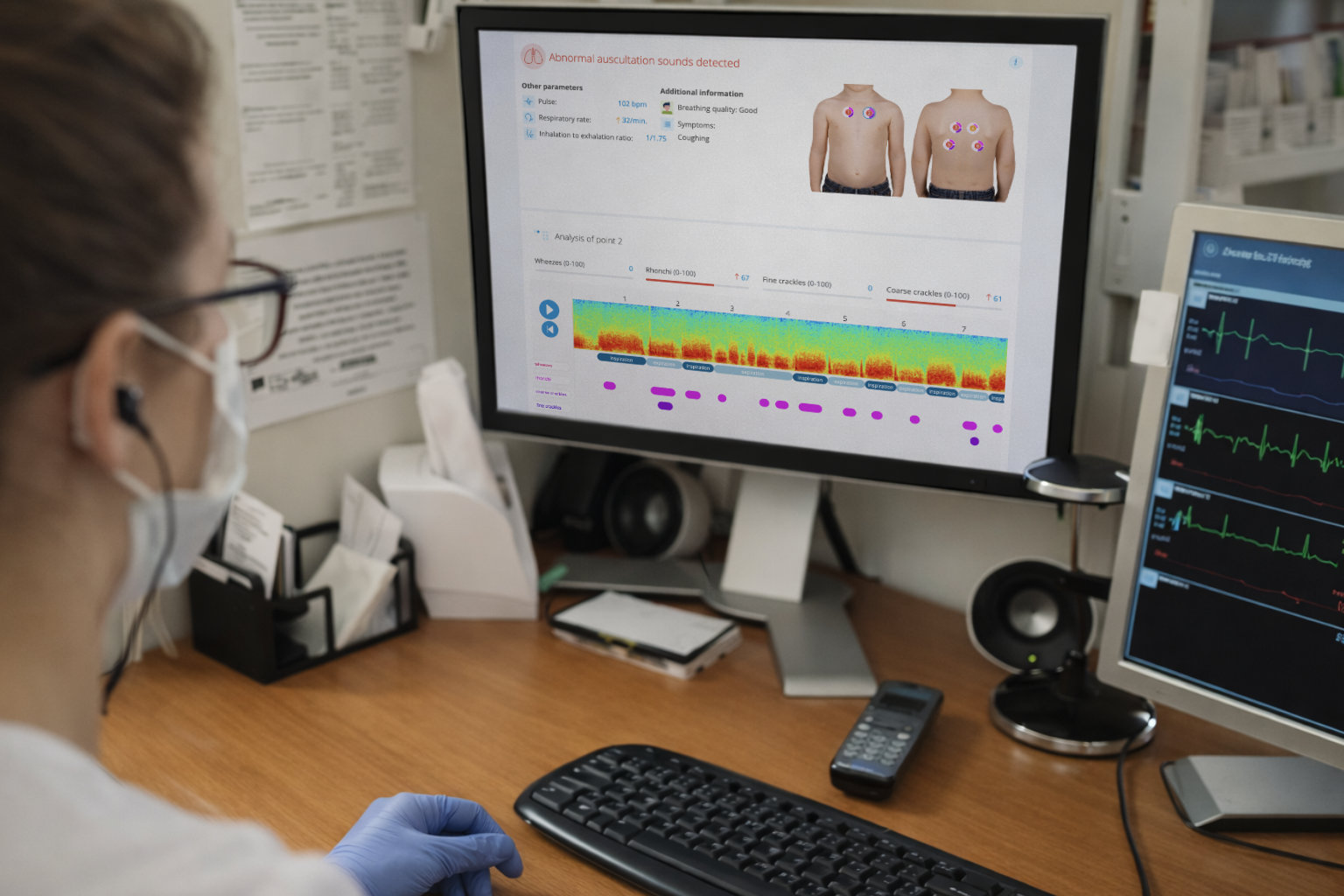
The proposed system was capable of automatically detecting and classifying four major categories of abnormal respiratory sounds: wheezes, fine crackles, coarse crackles, and rhonchi - the same pathological sounds routinely assessed by respiratory specialists.
Importantly, physicians would not receive only an audio recording. The system was designed to provide access to sound visualizations, spectrograms, and automated analytical reports, enabling a more objective assessment of respiratory events occurring outside the clinic.
The advantages of home monitoring extend far beyond convenience.
Children are generally less stressed when examined in their own environment. Families can avoid unnecessary clinic visits and reduce exposure to infectious diseases. Most importantly, physicians gain access to information recorded during the actual episode rather than relying on retrospective descriptions.
For children with asthma and other chronic respiratory diseases, this creates the possibility of observing respiratory symptoms as they naturally occur — during infections, after exercise, at night, or during periods of worsening disease control.
In many ways, this represents a shift from episodic assessment toward continuous observation.
Want to monitor your child's breathing between doctor visits? StethoMe detects abnormal lung sounds at home — the same way a doctor does, but available every day.
Learn about StethoMe